On this page
Almost every first-time manager is promoted for the wrong reason. Not a bad reason — just a different one: they were the best individual contributor on the team. The skills that earned the promotion are not the skills the new job requires, and the transition is usually handled with a congratulation, a bigger workload and a two-day course.
Then the predictable things happen. Feedback gets saved up for the annual review because giving it in the moment feels rude. Priorities are inherited rather than set, so the team does everything and finishes nothing. A performance problem is tolerated for eight months because the new manager hopes it will resolve itself. None of this is a character flaw. It is what happens when someone is given a job that runs on conversations nobody ever showed them how to have.
Written for HR, L&D and business leaders in Hong Kong organisations, particularly those promoting technical or sales specialists into their first people-management role.
The six capabilities that matter first
A management curriculum can sprawl for years. These six are the ones where the absence shows up as a real problem within the first six months.
| Capability | What goes wrong without it | How to build it |
|---|---|---|
| Giving corrective feedback | Issues surface at review time, months late, with no chance to fix | Scripted practice on a real case, then a debrief with the manager’s own manager |
| Setting priorities and saying no | The team absorbs every request and finishes nothing | Work a real backlog in the session; require a written stop-doing list |
| Running a one-to-one | Status updates, or cancelled meetings | A simple structure, one check-in template, and a rule that the direct report sets part of the agenda |
| Handling performance early | A tolerated problem becomes an HR case | A staged conversation model plus a practice run before the real one |
| Hiring and interviewing | Decisions made on impression rather than evidence | Structured interview practice against a real role profile |
| Knowing when to escalate | A harassment, safety or data matter sits with someone unsure what to do | A short decision rule: what must go to HR, compliance or legal immediately, with named contacts |
That last row deserves a note for Hong Kong employers. Compliance obligations frequently land on the front-line manager first — a safety concern, a harassment complaint, a question about handling employee records — and a new manager who does not know the escalation path will improvise. Improvisation is how a manageable incident becomes a reportable one.
Why the two-day course does not hold
Three reasons, all structural.
It is delivered at the wrong moment. A course attended before the person has any direct reports is abstract; they have no context to attach it to. Delivered three months in, it is too late for the mistakes that have already been made.
It teaches vocabulary, not behaviour. Knowing the phrase “situational leadership” does not make someone capable of telling a peer of ten years that their work is below standard. That capability is built by doing it, badly, then being corrected — which requires spaced practice and someone watching.
Nobody reinforces it afterwards. CIPD’s analysis of how L&D creates value makes the point that individuals are in L&D’s direct care only for the duration of a course, and that how they apply what they learned back in their teams is often beyond L&D’s control. The same research cites a 2022 YouGov study of over 2,000 workplace learners finding employees are more likely to hear about learning opportunities from their manager (38%) than from L&D (18%). The person who decides whether new-manager training becomes behaviour is the new manager’s own boss.
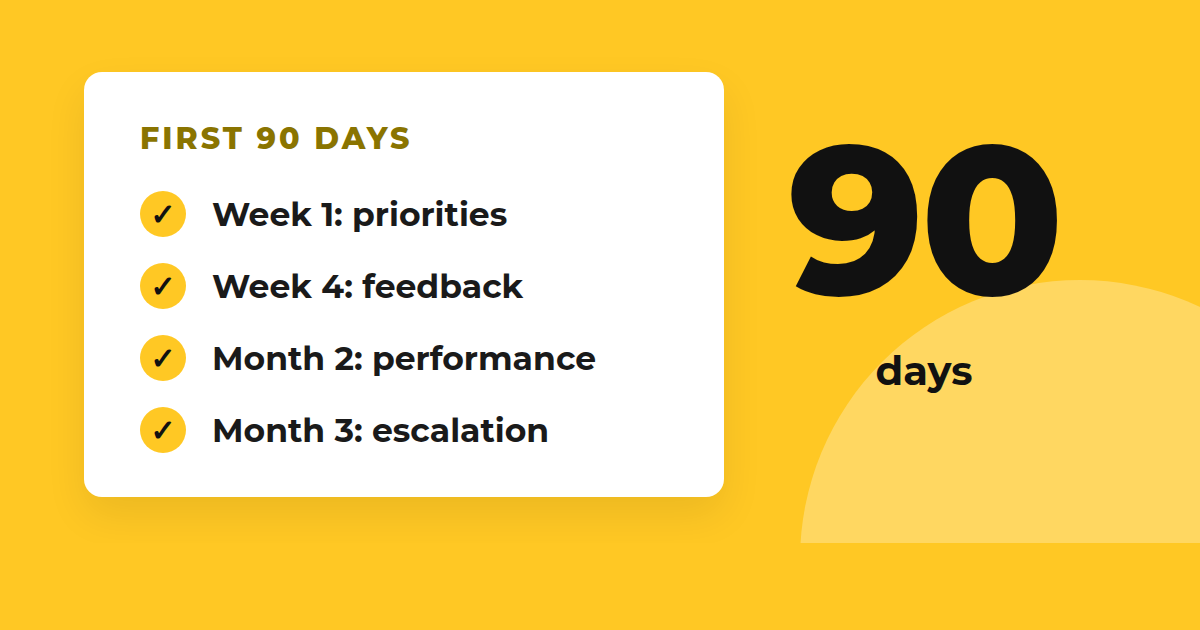
Timing it against the first 90 days
A workable shape for most organisations:
- Before the promotion takes effect — a half-day on the role change itself: what the job is now, what it is not, and what the first month will feel like. This is also the point to state expectations about one-to-ones.
- Week one — priorities. A working session on the actual team backlog, producing a ranked list and an explicit stop-doing list. Immediate, because the backlog is real on day one.
- Week four — feedback. Practice on a real conversation they are about to have, with a debrief. By now they have seen something worth commenting on.
- Month two — performance conversations and documentation. Timed before the first problem becomes serious.
- Month three — hiring and escalation, plus a review of what they have tried, what failed, and what they would do differently.
Two design rules make this work. First, every session uses the manager’s real cases, not invented scenarios — relevance is what makes practice transfer. Second, sessions are grouped in cohorts of peers, because the most useful thing about a new-manager programme is often discovering that everyone else is also finding it hard.
Matching the method to the content
Not everything in a management curriculum should be coached. CIPD’s coaching and mentoring factsheet defines both practices, distinguishes between them, and — usefully — includes a section on when coaching is the best development method. That is the right question to ask, and the answer is genuinely mixed:
- Coaching fits skill and confidence building in a real context: feedback conversations, prioritisation judgement, handling a difficult direct report. There is no single correct answer and the person needs to develop their own approach.
- Direct instruction fits obligations: what must be documented, what must be escalated, which regulatory requirement applies, what the company policy says. Here a wrong answer is a wrong answer, and a manager should not be coached towards it.
- Peer learning fits the things nobody has written down: how this organisation actually gets decisions made, which trade-offs are accepted, what “good” looks like in practice.
Mixing these badly is common and costly. Coaching someone towards an escalation threshold wastes their time and creates risk; lecturing someone on how to give feedback produces a manager who can describe it and still cannot do it.
The part most programmes forget: the manager above
If you only change one thing, change this. The new manager’s boss controls three things that decide whether any of the training lands: whether there is time to practise, whether trying the new behaviour is safe when it goes awkwardly, and whether they ask about it afterwards.
CIPD’s analysis argues that developing skills requires practice, permission and opportunity, and that L&D’s role is to equip managers to help their teams reflect, practise, adapt and build habits. Its practical suggestions translate cleanly here: give the boss a short check-in structure rather than a briefing pack, agree with them what their new manager will be trying to do differently, and ask them for one observation at a fixed interval. Three small asks, and the difference between a programme with behaviour change and one with attendance records.
What this looks like in a Hong Kong context
Three local conditions are worth designing around.
Thin management layers. In many Hong Kong SMEs and regional offices, a first-time manager may carry a full operational load alongside a team. Anything that adds hours to their week will be dropped. Design for short sessions and real work, not for study time.
Mixed-language teams. A manager may be running stand-ups in Cantonese, writing in English and reporting to a regional lead elsewhere. Feedback and performance conversations need practice in the language they will actually happen in — a script rehearsed in English is not the same conversation in Cantonese.
Compliance sits close to the front line. Where a manager is responsible for site safety, financial conduct or personal data handling, their training record is evidence. That is the case for pairing behavioural development with a trackable record: see mandatory safety training in Hong Kong for how certificate currency works, and what makes training records audit-ready for the fields that need to be captured. It increasingly also includes how a team may use AI tools, an expectation framed by regulators rather than statute: AI literacy training in Hong Kong is a useful reference for what a new manager is likely to be asked about first.
How to know whether it worked
Manager development is unusually hard to evaluate, which is exactly why it needs a plan written before the first session. Pick behaviour measures you can actually observe at 30, 60 and 90 days: are one-to-ones happening and are direct reports setting part of the agenda; has the manager held a documented performance conversation; is the team’s priority list published and being used. Then one outcome measure at six months — regretted attrition in the team, engagement results, or time-to-productivity for new joiners.
The framework for doing this properly is set out in how to measure training effectiveness, and the step that comes before it is running a training needs analysis rather than assuming all new managers need the same thing. They usually do not: the gap for a promoted engineer is different from the gap for a promoted salesperson, and a single programme that treats them identically will be too generic for both.
Building it
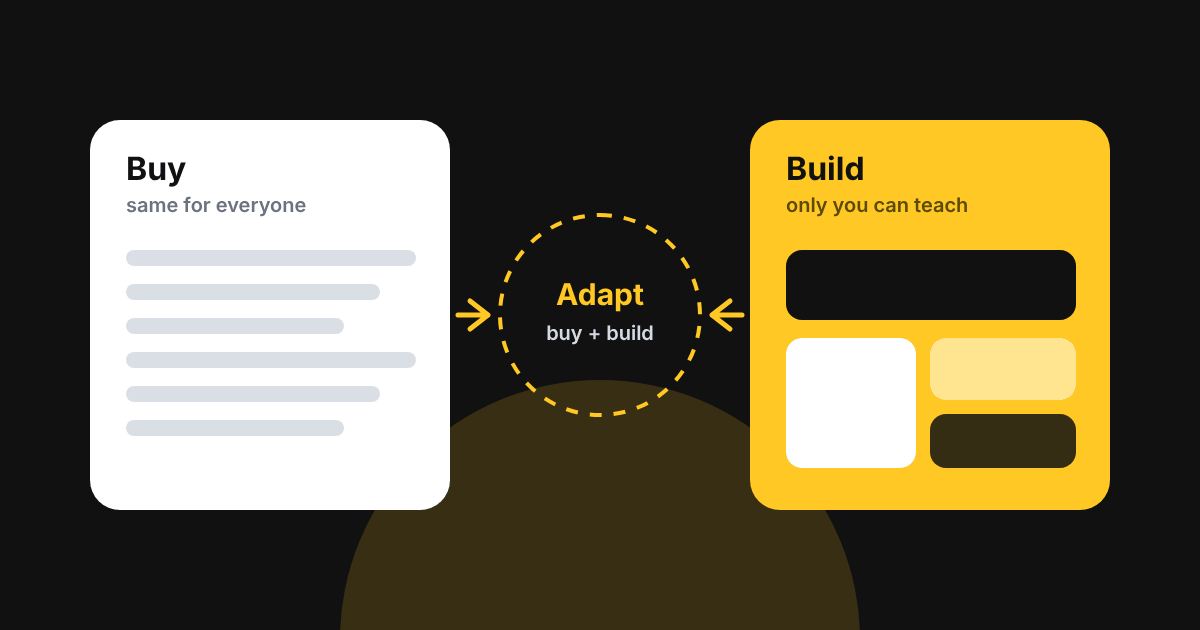
If the content needs to reflect your own policies, escalation paths and language, generic library titles will not carry it — that is the case for bespoke courseware, and the trade-off against off-the-shelf content is set out in off-the-shelf versus custom e-learning. For tracking who has completed what, and holding the evidence for compliance-linked elements, UpLearn is where that record lives.
Sources
- CIPD: Coaching and mentoring (factsheet)
- CIPD analysis: how L&D can create value — the role of the line manager
Cyberwisdom Asia Ltd. is a Hong Kong provider of learning management systems, CPD compliance software and bespoke courseware, serving 800+ enterprise clients since 1999.
About Cyberwisdom