On this page
A signed offer is not a productive employee. Between those two points sits onboarding, and in most organisations it is the least designed process in the employee lifecycle: a day of paperwork, a tour, a folder of policies, and then silence while the hiring manager improvises. The new hire spends the first month working out who is who and what actually matters, which is exactly the month when habits, impressions and engagement are formed.
The fix is not a bigger folder. It is treating onboarding as a programme with a start before day one, a defined structure, and an end point when the person is genuinely contributing. This article sets out how to design one: a framework to organise it, a 90-day arc, and the decisions that separate an onboarding programme from an onboarding event.
Written for HR, L&D and business leaders in Hong Kong organisations. The method is general; it works the same for an office hire in Kowloon and a frontline hire at the airport, and the notes on frontline and mixed-language teams at the end cover the local differences.
Onboarding versus induction: get the scope right
CIPD uses the word induction for the process of welcoming a new recruit, helping them settle in and making sure they have the knowledge and support they need to perform their role — and notes that first impressions have a significant impact on integration within the team and job satisfaction. SHRM’s guidance, building on Dr. Talya Bauer’s work for the SHRM Foundation, uses onboarding for the same territory and defines it more broadly.
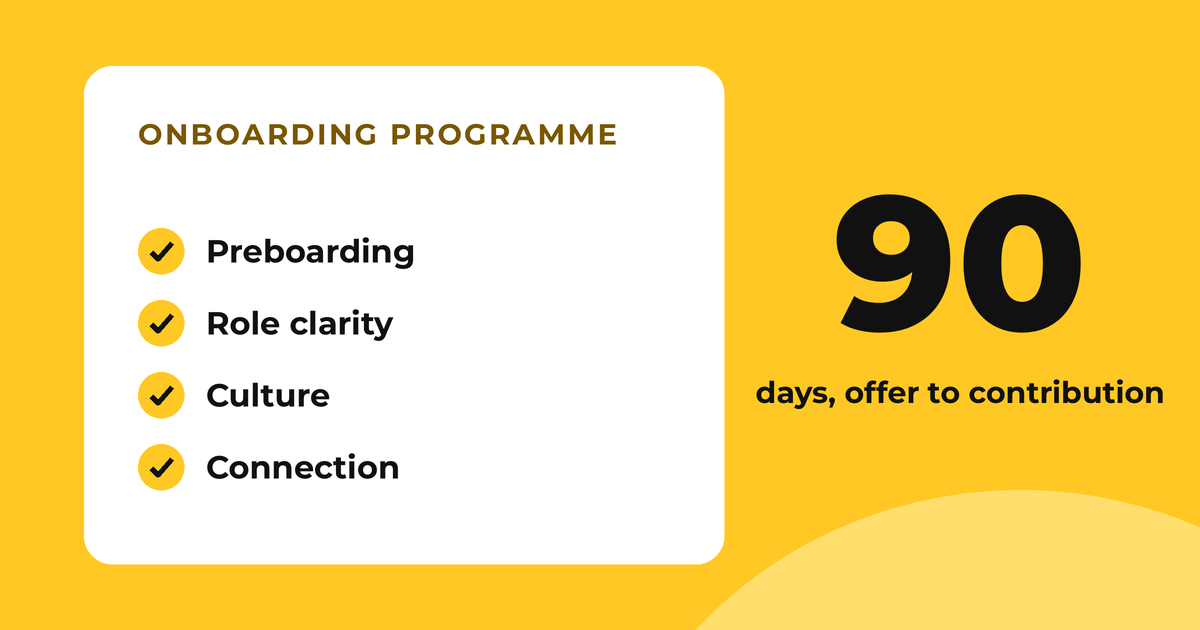
The practical distinction is not the word, it is the scope. An induction is typically an event: a day, maybe a week. Onboarding is a programme that runs from the moment the offer is signed until the person is performing independently — in practice, at least the first 90 days. Organisations that design only the event get exactly what they designed: a good first day followed by three unmanaged months.
The organising framework: the four C’s
Bauer’s research for the SHRM Foundation identifies four successive levels of onboarding, known as the four C’s. They are the cleanest available checklist for auditing any programme, because each one fails quietly and for different reasons:
| C | What it covers | The typical failure |
|---|---|---|
| Compliance | Basic rules, policies and procedures — the legal and administrative baseline | Usually done; often treated as the whole programme |
| Clarification | Understanding the job, expectations and how success is measured | Skipped because it needs the expectations written down |
| Culture | Formal and informal organisational norms — how things actually work here | Assumed to be absorbed by osmosis |
| Connection | Relationships and networks within the team and beyond | Left to chance; whoever happens to be friendly |
Bauer’s report also notes that self-efficacy — the new hire’s confidence that they can do the job — often determines how productive and successful a new employee becomes. That gives a fifth, implicit test: a programme that completes all four C’s but leaves the person feeling incompetent has still failed.
Use the table as an audit. For each C, ask what your programme actually does for every new hire, not just for the ones with attentive managers. If the honest answer to culture or connection is “it depends who their manager is”, that is a process gap, not a personality difference.
Phase zero: preboarding
Onboarding begins when the offer is signed, not when the contract starts.
A workable preboarding checklist is short:
- Equipment and system access ordered and ready before day one, so the first morning is not spent waiting for a password.
- A welcome message and a first-week schedule sent in advance, so day one has a shape.
- A buddy assigned and briefed — a peer, not the manager, who can answer the questions new hires hesitate to ask their boss.
- A drafted 30-60-90 day plan shared with the new hire, so expectations arrive before the work does.
- The team told who is joining, what they will own, and how to welcome them.
None of this is expensive. All of it signals that the organisation was paying attention.
The 90-day arc
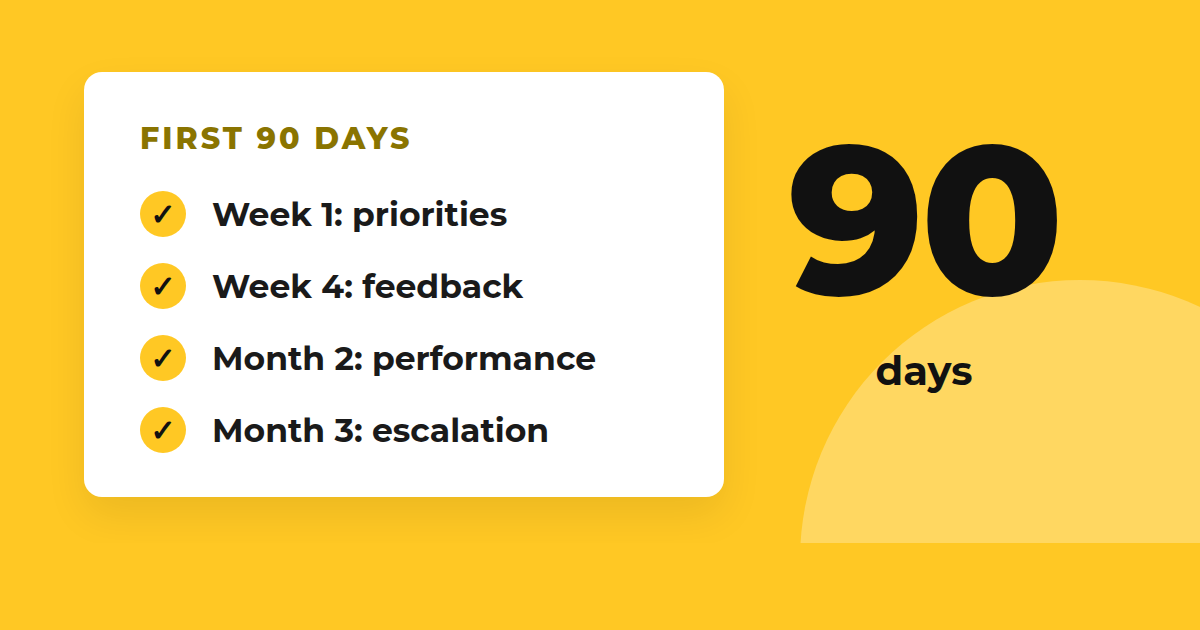
Bauer’s research note is blunt: employees get about 90 days to prove themselves in a new job, and the faster a new hire feels welcome and prepared, the faster they can contribute. Design the programme to the same window, in three phases with a different job for each.
Days 1–30: orient and connect. The goals are role clarity and relationships. The new hire should end the month knowing what is expected, who their key people are, and how their work fits the organisation. Training in this phase covers the tools, the processes and the compliance basics — but spread out, not stacked.
Days 30–60: contribute. Real work with a safety net. The manager shifts from orienting to coaching, the buddy relationship carries the informal questions, and the new hire gets early wins that are visible to the team. Training deepens into the role-specific content that generic induction cannot cover.
Days 60–90: perform and commit. The new hire operates independently. The 90-day review closes the formal programme: performance expectations confirmed, feedback collected in both directions, and a development conversation that treats onboarding as the first chapter of a career plan rather than the whole book.
Three structured check-ins — 30, 60 and 90 days — are the minimum cadence. Each one covers three questions: how the work is going, how the person is settling, and what the programme itself should fix before the next hire arrives.
Space the learning out
The most common delivery mistake is the week-one information dump: every policy, process and system in five days.
The design rule is simple: teach each thing at the moment the person first needs it to do real work. Policies and systems training lands in the first fortnight because it blocks everything else. Product depth, cross-functional processes and advanced tools land in weeks three to eight, when the person has context to attach them to. This is also where the format choice matters — see the trade-off in off-the-shelf versus custom e-learning — because role-specific onboarding content is where generic library titles are weakest and bespoke courseware earns its cost.
Who does what
The durable division of labour:
- HR designs the framework: the templates, the checklists, the compliance content, the training curriculum, and the measurement. Consistency across managers is the point.
- The hiring manager delivers the experience: check-ins, expectations, introductions, feedback. No framework substitutes for this.
- A buddy carries the informal layer: the unspoken rules, the lunch options, the questions that feel too small for a manager.
- L&D builds the content, and connects onboarding training to the wider development path — the analysis of what the role actually needs should come from a training needs analysis rather than a copy of last year’s deck.
One caution from the manager side: onboarding a new joiner is often a first-time manager’s first real test of structured one-to-ones and expectation setting. The capabilities they need for that are covered in first-time manager training, and building them in parallel makes both programmes work better.
What to measure
An onboarding programme without measurement cannot improve, because nobody knows which phase is failing. Three measures are usually enough:
- Milestone completion — are the check-ins, training items and first contributions happening on schedule, per hire, not just on average?
- New-hire feedback — short structured questions at 30 and 90 days, asking which of the four C’s felt thin. This is the cheapest programme-improvement data available.
- Time to contribution — when did the person first deliver real work unsupervised, compared with the plan?
The broader framework for evaluation — and why completion rates alone answer nothing — is set out in how to measure training effectiveness.
The Hong Kong specifics
Three local conditions shape the design more than any global template.
Mixed-language teams. Introductions, feedback and early coaching often happen in Cantonese or Putonghua while documentation is in English. Train the buddy and the manager for the language the conversations will actually happen in; a welcome pack in one language does not create connection in another.
Thin management layers. In many Hong Kong SMEs and regional offices, the hiring manager carries a full operational load. Anything that adds hours to their week will be dropped within a fortnight, so the framework must be short templates and scheduled check-ins rather than extra meetings.
Frontline and high-turnover populations. For retail, hospitality, logistics and security roles, the 90-day arc compresses: contribution is expected in days, and the training content — procedures, safety, service standards — is more standardised, which makes it well suited to structured e-learning delivered through a platform. What does not compress is connection; a frontline buddy matters more, not less, because the informal network is how a new frontline hire learns the job that is not in the SOP.
For tracking who has completed what across a mixed population — office and frontline, multiple languages, different checklists per role — UpLearn is where the programme’s tasks, training records and check-in evidence live, which is also what makes the measurement above possible without a spreadsheet exercise.
Start with the checklist, not the ambition
A good onboarding programme is not elaborate. It is a preboarding checklist that always happens, four C’s with a deliberate answer each, three phases across 90 days, three check-ins with named owners, and feedback that actually changes the next hire’s experience. Audit your current programme against the four C’s table this week; the gaps will tell you what to build first.
Sources
- SHRM: Reducing new employee turnover among emerging adults (on Bauer, Onboarding New Employees: Maximizing Success)
- CIPD: Induction factsheet
Cyberwisdom Asia Ltd. is a Hong Kong provider of learning management systems, CPD compliance software and bespoke courseware, serving 800+ enterprise clients since 1999.
About Cyberwisdom