On this page
Most Hong Kong organizations now have employees using generative AI whether or not anyone approved it. The training question that follows is not “should we teach AI”, but “what exactly must each group of staff know, and how would we prove we taught it”. This guide sets out what regulators have actually said, a four-tier programme structure, and what to record.
Sources checked on 25 October 2026 against the publications listed at the end. AI guidance is moving quickly; confirm the current text with the regulator before relying on it, and treat this as general information rather than legal advice.
What the regulators have actually said
The PCPD checklist (March 2025)
The Office of the Privacy Commissioner for Personal Data published the Checklist on Guidelines for the Use of Generative AI by Employees in March 2025. It helps organizations write an internal policy or guideline for staff using generative AI at work, while complying with the Personal Data (Privacy) Ordinance. It recommends that the policy cover:
| Area | What the checklist asks for |
|---|---|
| Scope of permissible use | Which generative AI tools are permitted (public tools, internally developed tools, or both), what they may be used for, and which employees or departments the policy covers |
| Protection of personal data privacy | What kinds and amounts of information may be entered, what the output may be used for, how output may be stored, and the retention rules that apply |
| Lawful and ethical use, prevention of bias | No unlawful or harmful use; employees must verify accuracy and fact-check output; correct and report biased or discriminatory output; instructions on watermarking or labelling |
| Data security | Permitted devices, categories of permitted users, strong user credentials, security settings, and reporting of AI incidents such as unauthorized input of personal data |
| Consequences of breach | What happens if the policy is breached, with reference to the PCPD’s model framework for AI governance |
The checklist also includes practical tips for supporting employees, and one of them is training: educate employees on how to use generative AI tools effectively and responsibly, explain the capabilities and limitations of the tools, provide practical tips and examples, and encourage staff to read the privacy policies and terms of use of the tools they use. The same publication recommends communicating the policy regularly and keeping staff informed of updates.
For context, the PCPD has reported that a 2024 survey on enterprise cyber security readiness and AI security found only 28% of enterprises had established AI security policies. That gap is the reason this is a training problem and not only a policy-writing problem.
The HKMA’s competence expectations (August 2025)
Banks have a separate and more direct expectation. In its circular of 18 August 2025 on Capacity Building for Future Banking, 2026-2030, issued with the Hong Kong Association of Banks and the Hong Kong Institute of Bankers, the HKMA listed specialist technical expertise in artificial intelligence, data analytics and governance, and cybersecurity among the skills most in demand, alongside human-machine interaction skills and sustainable finance risk knowledge.
The circular reminds authorized institutions that Supervisory Policy Manual module CG-6 on Competence and Ethical Behaviour already sets out expectations to develop staff professional competence and keep skills up to date, including assessing the impact of technological change and maintaining effective reskilling plans. Institutions are expected to adjust their training and reskilling plans, support staff learning new skills, and make use of internal and external training programmes. Locally incorporated licensed banks are expected to have their boards assess the effectiveness of those plans regularly, and the HKMA says it will evaluate individual banks’ performance in this area.
The study proposed an A.S.C.E.N.D. action plan: advocate local professional training and qualifications, synergise reskilling and upskilling, commit to a culture of continuous learning, evaluate the Enhanced Competency Framework for updates, nurture and attract future talent, and devote effort to industry-wide capacity building initiatives.
A four-tier programme structure
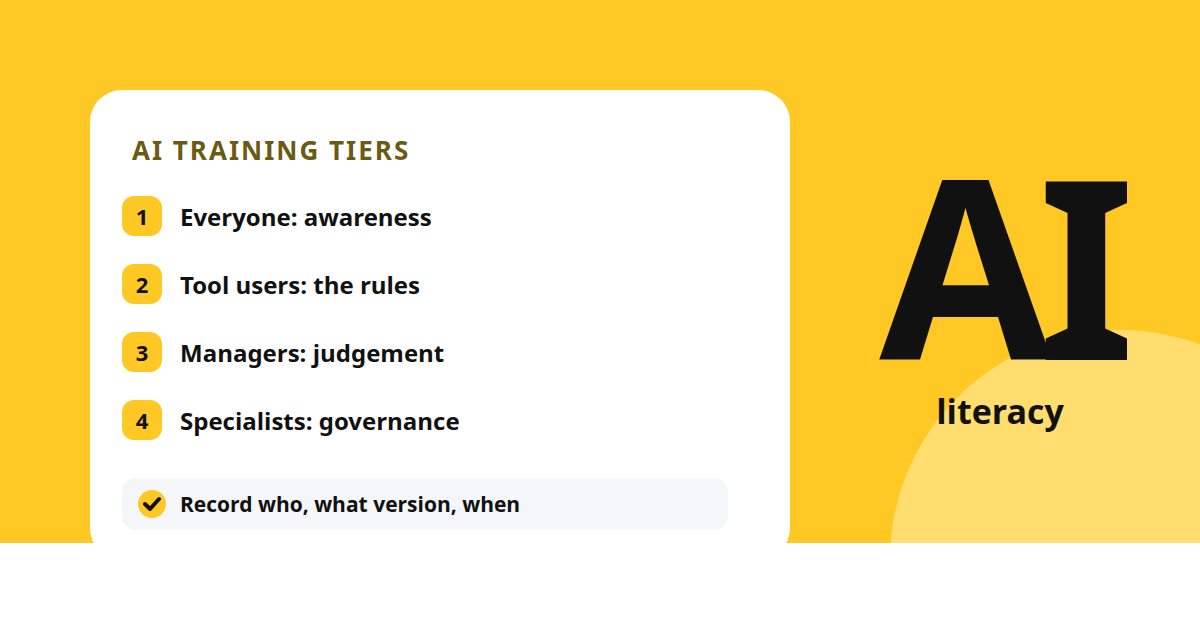
AI literacy is not one course. The audience determines what must change in behaviour, and therefore what the training has to contain.
| Tier | Audience | What they must be able to do | Suitable format |
|---|---|---|---|
| 1. Awareness | All staff | Recognize when they are using AI, know which tools are permitted, know what data must never be entered, and know how to report an incident | Short e-learning module, 20-30 minutes, annual refresher |
| 2. Tool users | Staff who use generative AI in daily work | Verify output, label AI-generated content, avoid bias and privacy pitfalls, apply the organization’s rules to their own tasks | Role-based module with scenarios and assessment |
| 3. Managers | Team leaders and approvers | Interpret the policy for their team, judge when AI use is appropriate, escalate incidents, and know what evidence their team’s training must produce | Workshop plus a short decision guide |
| 4. Specialists | AI, data, risk, compliance and security staff | Govern the tools, assess risk, keep the policy current, and design controls | External certification and specialist programmes |
Two practical notes. First, tier 1 and tier 2 are the tiers most organizations skip: the policy exists, but nobody has taught the people who will actually paste data into a chatbot. Second, tier 3 is where audits usually fail, because the manager who approved the use case cannot point to a record of what their team was taught.
What to build and what to buy
The split follows the same logic as any other compliance-adjacent topic: buy the general, build what is yours.
- Buy the conceptual layer: what generative AI is, where it fails, how bias appears, why output must be verified. This is the same for every organization.
- Build the rules layer: your permitted tool list, your data restrictions, your labelling convention, your incident route, your consequences. No off-the-shelf course knows these.
- Keep both versioned. When the policy changes, the course has to change with it, and the old version has to remain retrievable as evidence of what staff were told at the time.
Cyberwisdom builds this kind of course as bespoke courseware, delivered as SCORM packages so it runs in UpLearn or in the LMS an organization already operates.
What to record
AI training is a policy communication exercise, so the record has to be able to answer “who was told what, and when”.
- Learner, completion date and assessment result.
- The version of the course, and the version of the AI policy it was built from.
- Which role or population the person belonged to, since tiers differ.
- The refresher cycle and who is overdue.
- A retention period consistent with your own record-keeping obligations.
If any of this feeds a professional body’s CPD or a regulator’s competence requirement, the hours and topic tags have to be captured at completion, not reconstructed later. The Cyberwisdom CPD Engine exists for that reason, and it is worth deciding early whether AI training should count as structured learning for your regulated staff.
A short checklist before you start
- Write or find the AI policy first. Training built before the policy exists will be rewritten.
- Identify which tools staff are actually using, including tools embedded in software they already have.
- Map the four tiers to real populations, with named owners for each.
- Decide the refresher cycle and tie it to policy review.
- Decide what evidence you would produce if asked, and check your system can produce it today.
- Assess understanding, do not just track attendance.
Where a system helps
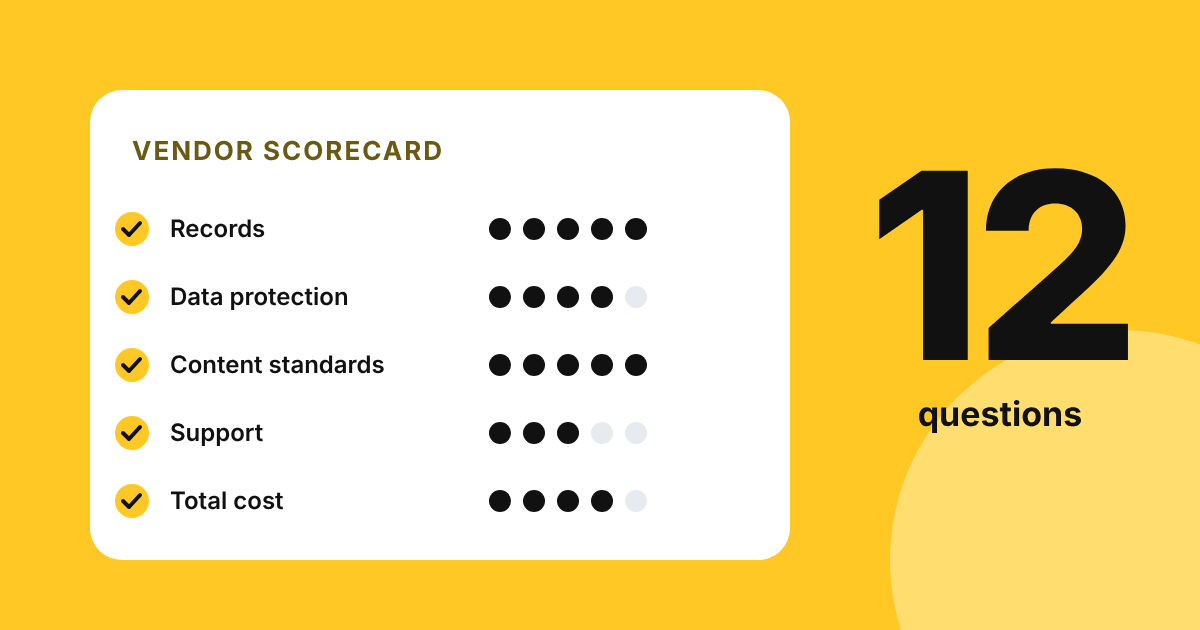
AI training has two properties that make spreadsheets awkward: the content changes when the policy changes, and different populations need different versions at the same time. An LMS lets you assign by role, version the course, reassess after a policy update, and report completion by population with dates attached. If you are still comparing platforms, how to choose an LMS covers the twelve questions worth asking a vendor. Cyberwisdom is a Hong Kong provider of learning management systems, CPD compliance software and bespoke courseware, serving 800+ enterprise clients since 1999.
Sources
- PCPD: Checklist on Guidelines for the Use of Generative AI by Employees (March 2025)
- PCPD: Artificial Intelligence: Model Personal Data Protection Framework (June 2024)
- HKMA circular: Capacity Building for Future Banking, 2026-2030 (18 August 2025)
- HKMA: Briefing to the Legislative Council Panel on Financial Affairs (2 February 2026)
Cyberwisdom Asia Ltd. is a Hong Kong provider of learning management systems, CPD compliance software and bespoke courseware, serving 800+ enterprise clients since 1999.
About Cyberwisdom