On this page
What the breach figures actually say
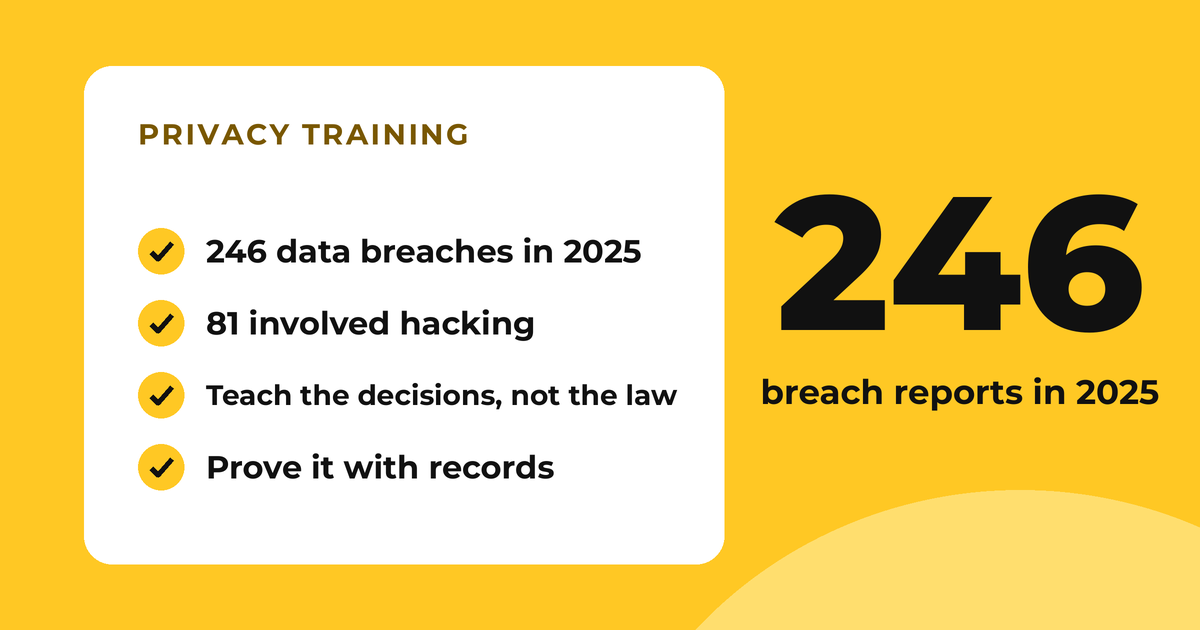
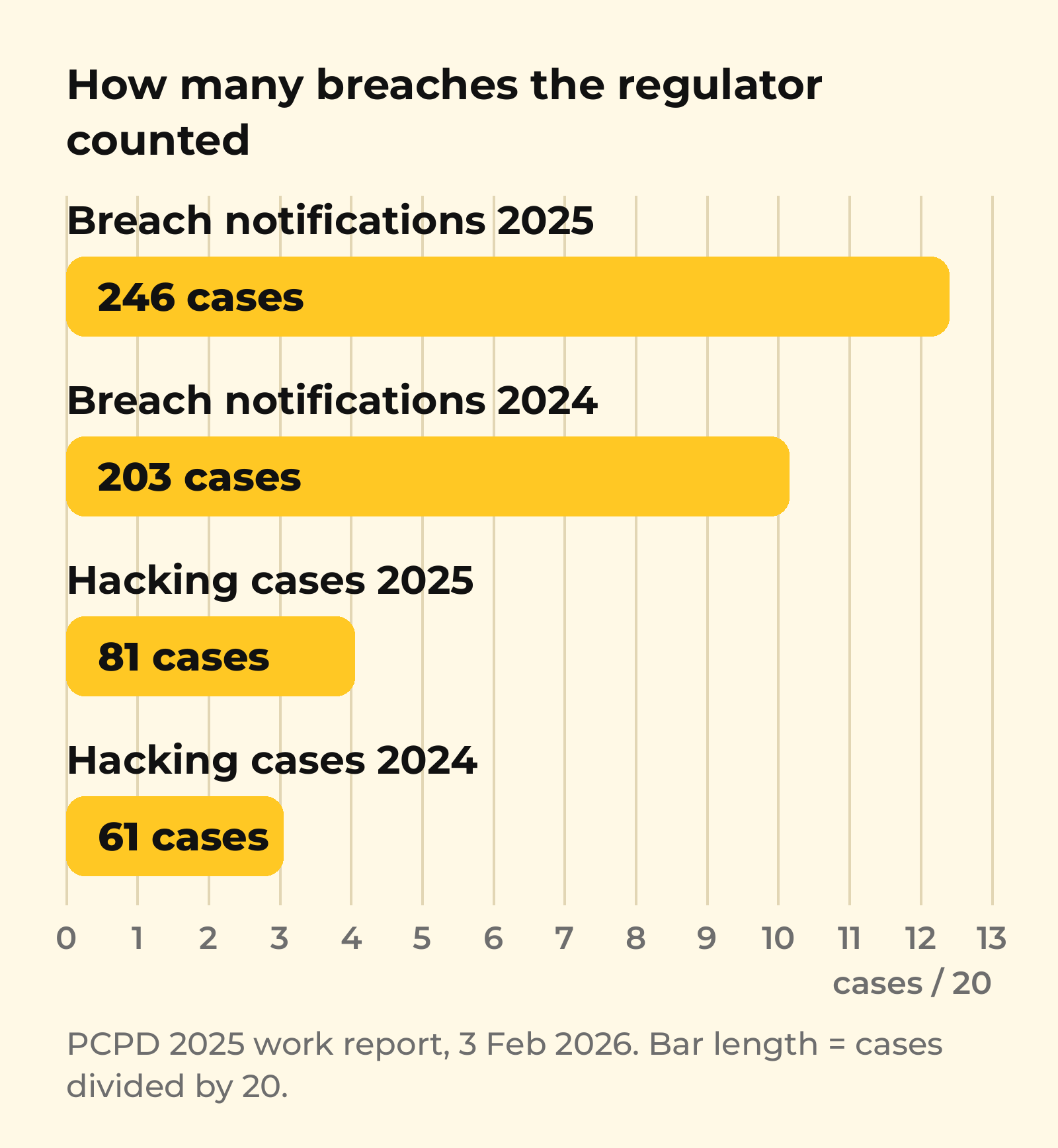
As of 6 November 2026, the most recent published count from the Office of the Privacy Commissioner for Personal Data is for 2025. The press statement for the PCPD’s 2025 work report carries the date 3 February 2026. In it, the office said it received 246 data breach notifications during the year — 79 from public organisations and 167 from private ones — against 203 in 2024, an increase of 21%. Hacking accounted for 81 of them, or 33%, against 61 in 2024, itself up 33%. The same report recorded 4,228 complaints in 2025, up from 3,431, and 435 compliance checks, up from 400.
Read as a training brief, those numbers say something specific. Hacking is one cause among several; the report lists the others as lost documents or portable devices, personal data disclosed accidentally by email, post or fax, staff breaches and system misconfiguration. A privacy awareness programme that spends all its time on external attackers is preparing staff for the smaller share of the problem. The larger share is a person in the organisation doing something ordinary — copying a card, attaching the wrong file, replying to the wrong thread — and that is exactly what a well-designed course can address.
Why a privacy course is usually built the wrong way
The standard privacy course is a tour of the law. It works through the data protection principles one after another, defines a data subject and a data user, and ends with a multiple-choice quiz. People pass it, the completion rate looks healthy, and the following year the same misdirected email appears in a breach notification.
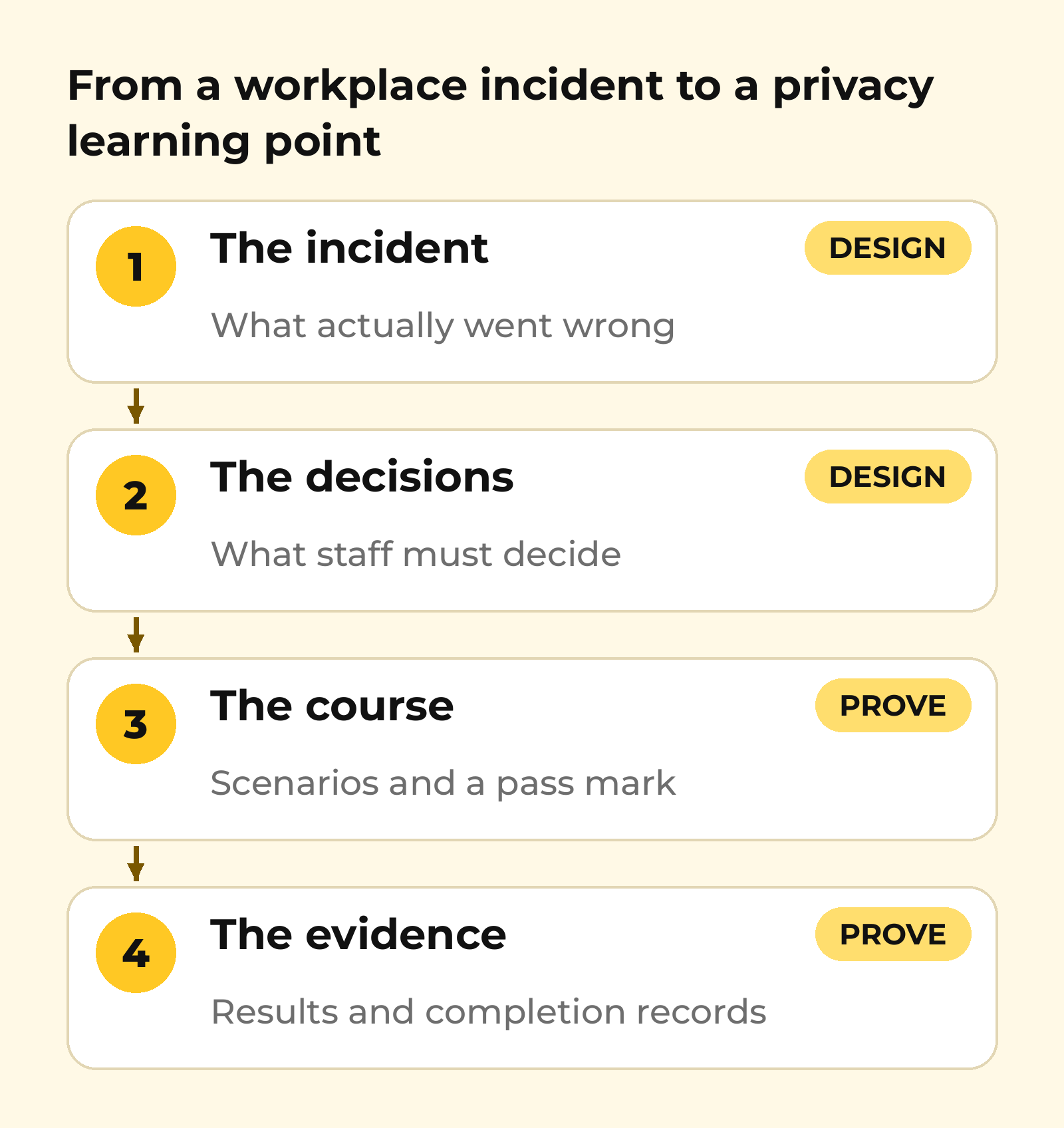
The reason is that a legal structure and a decision structure are not the same thing. A requirement such as “the collection must be adequate but not excessive” is a good test for a policy, but it is not a decision anyone can make at a counter. The decision at the counter is: does this customer need to hand over an identity card copy for this transaction, or is there a less intrusive way to verify identity? That question has an answer a person can learn, practise and be tested on.
The PCPD’s own case notes follow the same logic. In case note 2023E01, the office was asked whether an employer could require staff to install an attendance app on their personal phones with facial recognition and GPS enabled. The answer did not begin with a section number. It said the Ordinance is principles-based and technology-neutral, that the employer must consider whether collecting the specific data is necessary for attendance, and that it must assess whether biometric data is appropriate, necessary and proportionate in the circumstances, and whether other, less privacy-intrusive means could achieve the same purpose. That is the shape of a good training scenario: a real request, a set of alternatives, and a standard for choosing between them.
Five decisions worth building the course around
A privacy course does not need to cover everything. It needs to cover the decisions where the organisation’s exposure is concentrated. Five recur in Hong Kong workplaces and map cleanly onto the incidents the regulator reports.
Collecting an identity card copy. Whether to ask for it, what to do with it afterwards, and how long to keep it. The teaching point is the alternative: if another method verifies identity, the copy is the more intrusive option.
Sending data to the wrong person. One wrong address, one autocomplete. The teaching point is a habit, not a rule: check the recipient and the attachment before sending, and report immediately if it happens, because the speed of the response changes what the organisation can still do.
Moving work data onto personal devices and accounts. A spreadsheet on a personal phone, a customer list in a personal email account. The teaching point is that the organisation’s duty to protect the data travels with the data.
Handling an access or correction request. A customer asks what data is held about them, or asks for it to be corrected. Staff need to recognise the request and route it, rather than answer it informally.
Using another person’s data in a way that could cause harm. The 2021 amendment criminalised doxxing and set two tiers of penalty: a lower tier on summary conviction, and a higher tier on indictment where the victim or a family member also suffers actual specified harm. The lower tier carries a fine of HK$100,000 and 2 years in prison; the higher carries a fine of HK$1,000,000 and 5 years in prison. For most staff this is not a compliance procedure; it is a line that a staff member with a personal grievance might cross without realising it.
Each of these can be taught in a few minutes, tested with a scenario, and reported on by question. What staff then hold is not a summary of the law but a set of decisions they have already made once in a safe place.
What the platform has to do so the record survives
A privacy programme is examined in a particular way. A compliance review, an internal audit or a customer’s due diligence will not ask how many people watched the video. They will ask which version of the course was taught, who completed it, what they were tested on, and how completion was judged.
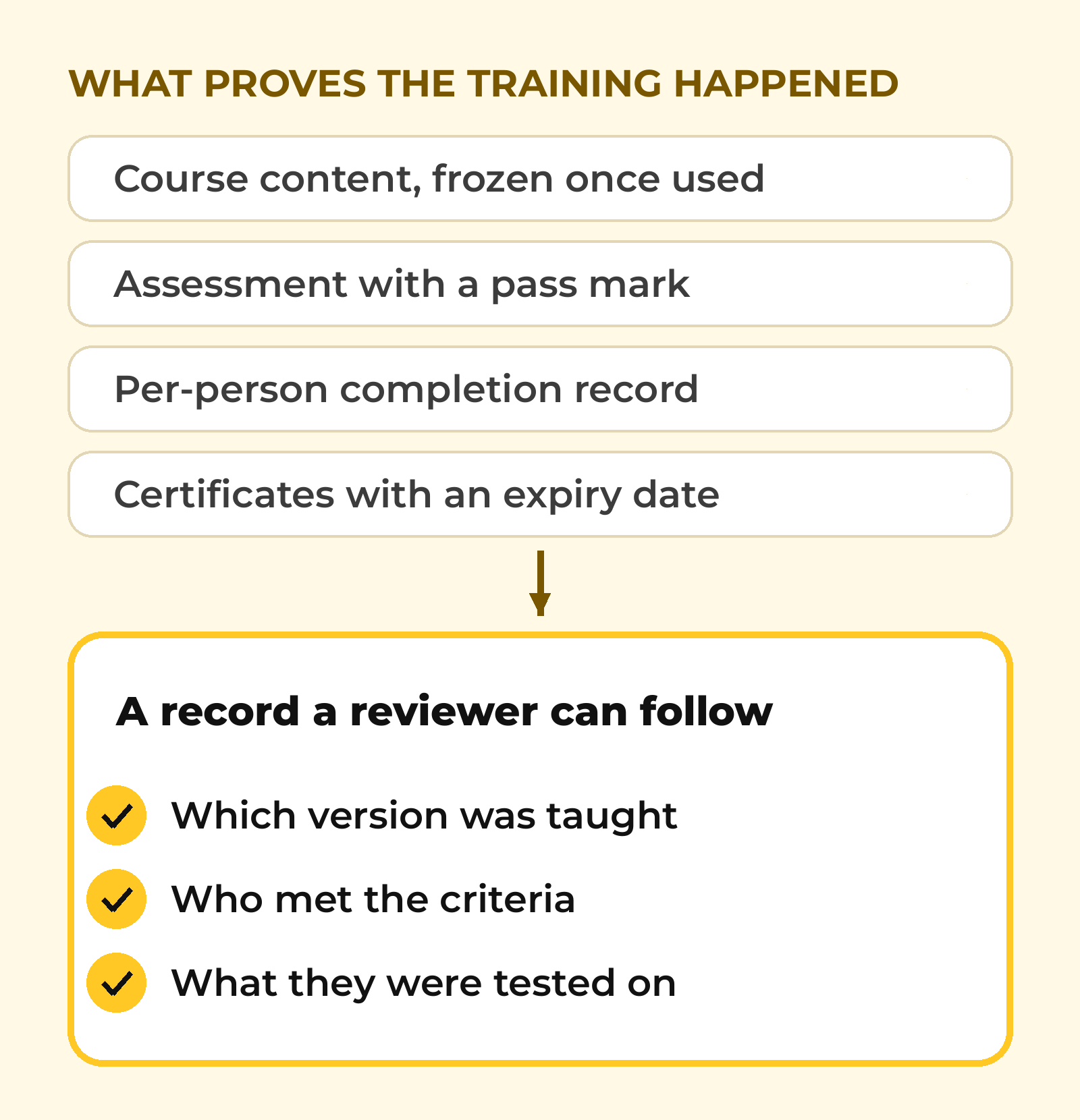
That is where a learning platform stops being a delivery tool. In UpLearn, completion criteria are set per course and checked automatically after each learning activity and each grading (R-01), so “completed” is a judgement made against a rule rather than a hand-written note. Each enrolment ends in one of four statuses, and a learner still short of the criteria at the course end date turns into a fail automatically (R-02), which means a completion report cannot quietly contain people who never finished. Once learners have accessed a course, its modules can no longer be edited or deleted (R-06), so the record and the content it refers to stay aligned even after the next revision. Quiz rules include a pass mark, attempt limits and administrator-controlled start (L-05), and question-level statistics show where a cohort is still getting a scenario wrong (D-03). Certificates can carry an expiry date with reminders before they lapse (R-10), which suits an annual privacy cycle.
Where the organisation also wants to see the data protection duties reflected in a course that is not generic, that is a courseware question rather than a platform one: the scenarios should come from the organisation’s own incidents and processes, which is why a short custom module often teaches more than a longer off-the-shelf one.
The two failures worth rehearsing
One is the record failure: the course exists, the completion rate is reported to the board, and no one can produce the version that was taught or the assessment result behind the number. The other is the decision failure: the course was excellent, and the first week after it ends, a staff member emails an unredacted customer list to a group of colleagues because nobody had rehearsed that exact moment.
Both are cheap to prevent and expensive to discover. The first is prevented by freezing content once it is in use and by recording assessment results alongside completion; the second by putting the organisation’s own incidents into the scenarios and by letting the question-level results show which decision is still the weak one. Neither needs a longer course. Both need a course that was designed around what people actually do on an ordinary working day.
Sources
- Office of the Privacy Commissioner for Personal Data: 2025 work report press statement, 3 February 2026
- PCPD: Personal Data (Privacy) (Amendment) Ordinance 2021, including the two-tier doxxing offences and penalties
- PCPD case note 2023E01: attendance app with facial recognition and GPS on a personal phone
Cyberwisdom Asia Ltd. is a Hong Kong provider of learning management systems, CPD compliance software and bespoke courseware, serving 800+ enterprise clients since 1999.
About Cyberwisdom