On this page
A three-year licence measured two years at a time
Hong Kong’s property management licensing regime finished its three-year transitional period on 31 July 2023. At that point the PMSA reported nearly 750 licensed property management companies and over 12,000 licensed practitioners, which is the size of the population this requirement now covers.
Mandatory CPD arrived in stages: Tier 1 licence holders from 1 January 2024, Tier 2 holders from 1 January 2025. From 1 August 2023 the PMSA has, under the Property Management Services (Licensing and Related Matters) Regulation, imposed a condition on newly issued or renewed Tier 1 licences, which run for three years, requiring the holder to meet the annual requirement “for each year … in the two immediate CPD years before the expiry year” of that licence.
The wording carries its own arithmetic, and it is worth doing slowly. For a licence issued or renewed from 1 August 2023, the PMSA’s text points to an expiry year of 2026 as the first year the condition bites. The two CPD years immediately before 2026 are 2024 and 2025. The rest of 2023 — the year the licence was actually granted — is not one of them. The pattern generalises: whatever the year in which the licence expires, the two years that count are the two immediately before it.
Two consequences follow that are easy to miss on a first reading.
The first is that a person can do a great deal of training in the first year of a licence and still fail the condition, because the first year is often not one of the two that are assessed. Three years’ worth of hours delivered in the wrong year is worth nothing at renewal, while the requirement met in each assessed year is worth everything. The instinct to front-load, or to catch up in a quiet quarter, does not fit a rule written this way.
The second is that the expiry year, not the calendar, sets each person’s clock. In a company whose practitioners took out their licences in different months, there are several different two-year windows running at once, and the year that matters for each person changes when the licence is renewed.
Tier 2 has a seam of its own. Because mandatory participation began for Tier 2 in 2025, a Tier 2 licence issued or renewed between 1 August and 31 December 2023 is measured on one year only — 2025 — before its 2026 expiry. Licences issued or renewed from 2024 onwards are measured on the usual two years before their expiry year. The scheme does not provide a single template that can be applied to everybody in the same year.
Four numbers hide inside the twelve
The headline number is the least interesting part of the requirement. Underneath it sit three further tests, and each one removes a way of assembling the total.
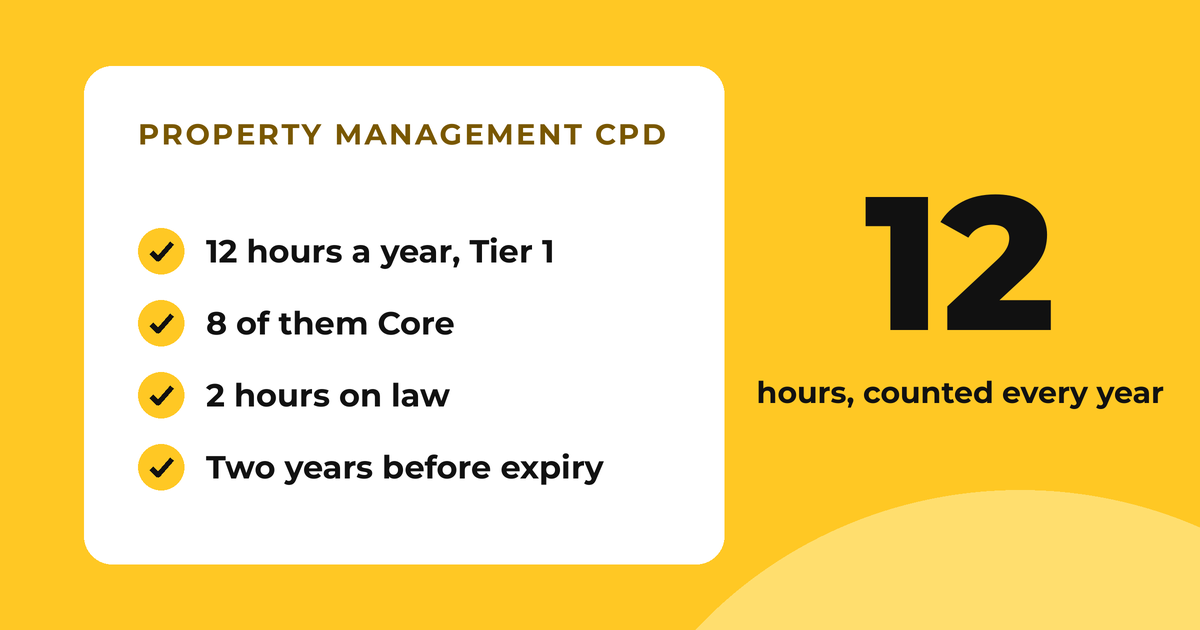
For Tier 1, at least 8 of the 12 hours must come from activities the PMSA classes as Core, no more than 4 may come from activities it classes as Unofficial, and at least 2 must relate to law and regulations. For Tier 2 the same structure applies at half scale: 6 hours in total, at least 4 Core, no more than 2 Unofficial, and 2 hours on law and regulations.
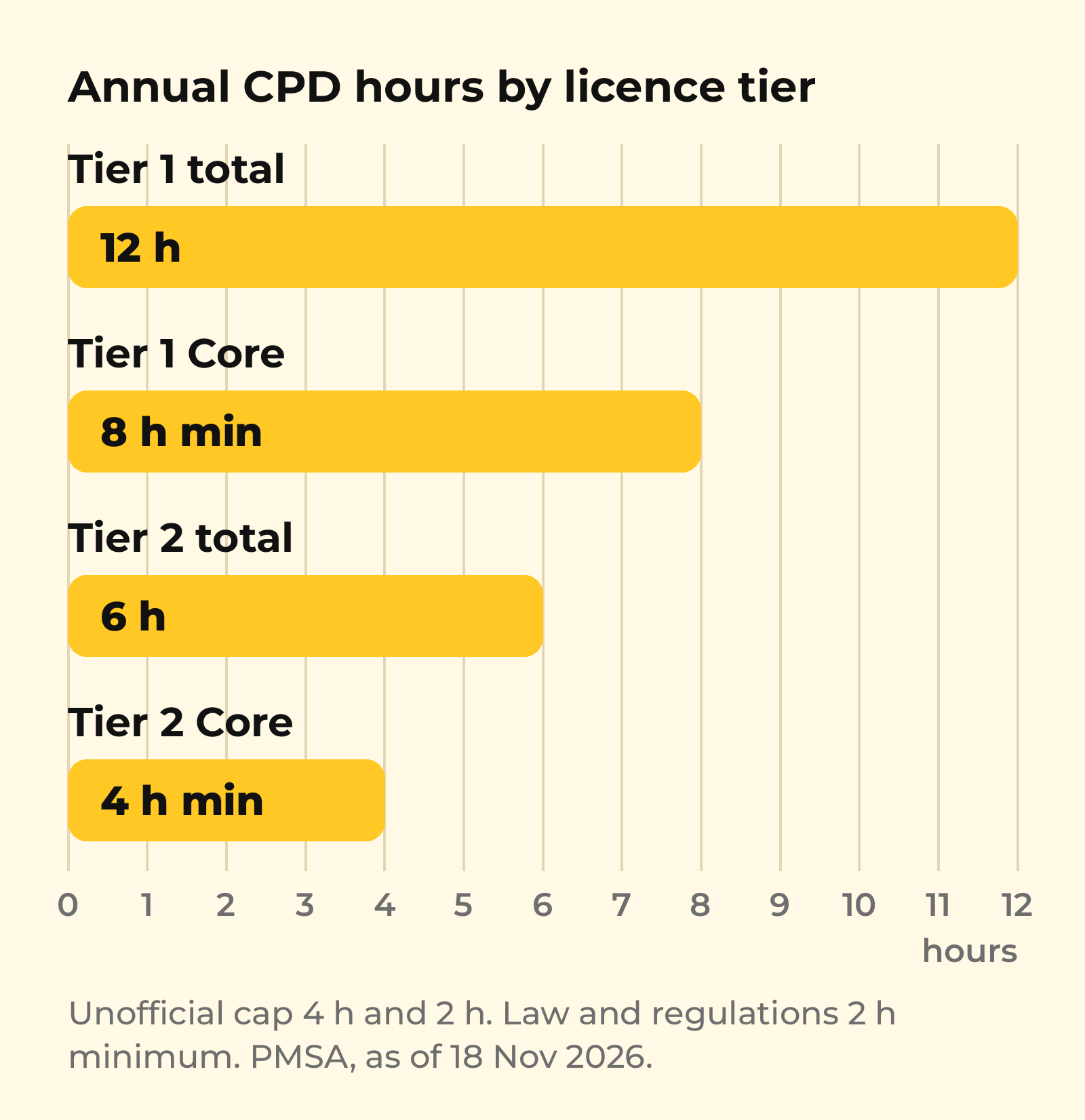
A hypothetical makes the failure mode concrete. A Tier 1 practitioner attends twelve hours of seminars during the year: six on customer service and communication, six on building maintenance practice. The total is met exactly. But if only six of those hours were Core activities, the year fails on the Core minimum even though the number looks right; and if none of the six customer service hours related to law and regulations, the two-hour law requirement fails as well. The practitioner has done the hours and not met the requirement, which is a different and more expensive problem than doing too few hours.
The counting rules add a second layer. Face-to-face activities and courses are counted in minimum units of one hour; online activities and courses in minimum units of 30 minutes. A single activity is capped at 5 CPD hours, while academic courses carry no maximum, and a course that spans more than one CPD year is counted by the hours actually attended in each year.
The per-activity cap is the rule that quietly changes how a training calendar should be built. A conference that runs longer than the cap contributes the cap, not the hours attended. Two shorter sessions on the same subject, delivered on different dates, can contribute more between them than the single long day did. None of this is a reason to design training around the counting rules, but it is a reason to check the count before announcing that a programme has covered the year.
The scheme classifies activities by content and by learning mode, and the gap between “hours attended” and “hours recognised” is where most of the year-end arguments happen. The published requirements also describe the test year by year; nothing in them provides for carrying surplus hours from one CPD year into the next. A practitioner who finishes one year well above the requirement has a comfortable margin in that year and no credit in the next.
Why the calendar has to be settled before the year starts
The requirement is not only about what a practitioner attends. It is also about whether the activity was recognised at the time it happened, and that is decided upstream of the attendance record.
PMSA recognises activities and courses in advance, on the basis of their content and learning mode. Courses organised by recognised professional bodies, and by property management companies specified under the scheme, can be recognised where they meet the criteria. Activities and courses organised by government or public bodies, and courses run by institutions regulated by the Education Bureau or accredited by the Hong Kong Council for Accreditation of Academic and Vocational Qualifications, are recognised automatically and need no advance approval.
A company’s own in-house session is not in that automatic list. It can still count, but the recognition step has to be completed before the session runs, not reconstructed afterwards when somebody notices that the year is short.
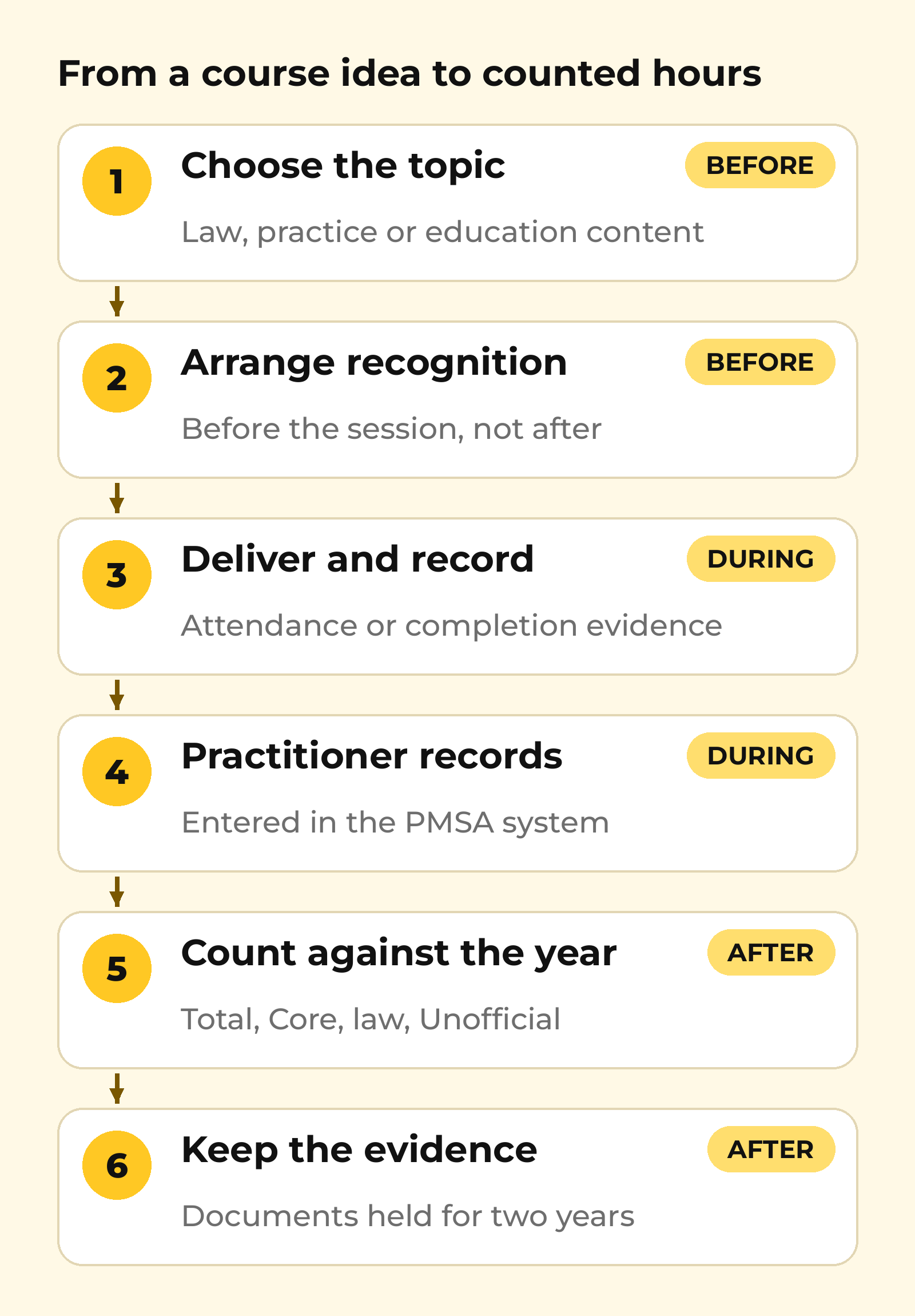
That ordering has a practical consequence for anyone planning a year of training. The useful planning question is not “what shall we run in November” but “which of our sessions will be recognised, for which category, and when does the recognition have to be in place”. A course designed in October for delivery in December can miss the recognition window entirely, and no amount of attendance evidence will convert it afterwards.
One carve-out is worth knowing because it appears in the scheme booklet rather than in the headline requirements: provisional PMP licensees who complete the PMSA Specified Courses during a CPD year are treated as having met the CPD requirements for that year. For a company hiring newly qualified staff, that changes the shape of the first year, and it is the kind of detail that a general “everyone needs twelve hours” briefing will erase.
Whose record it is, and who gets audited
The obligation and the evidence are held by different parties, and the gap between them is the operational risk.
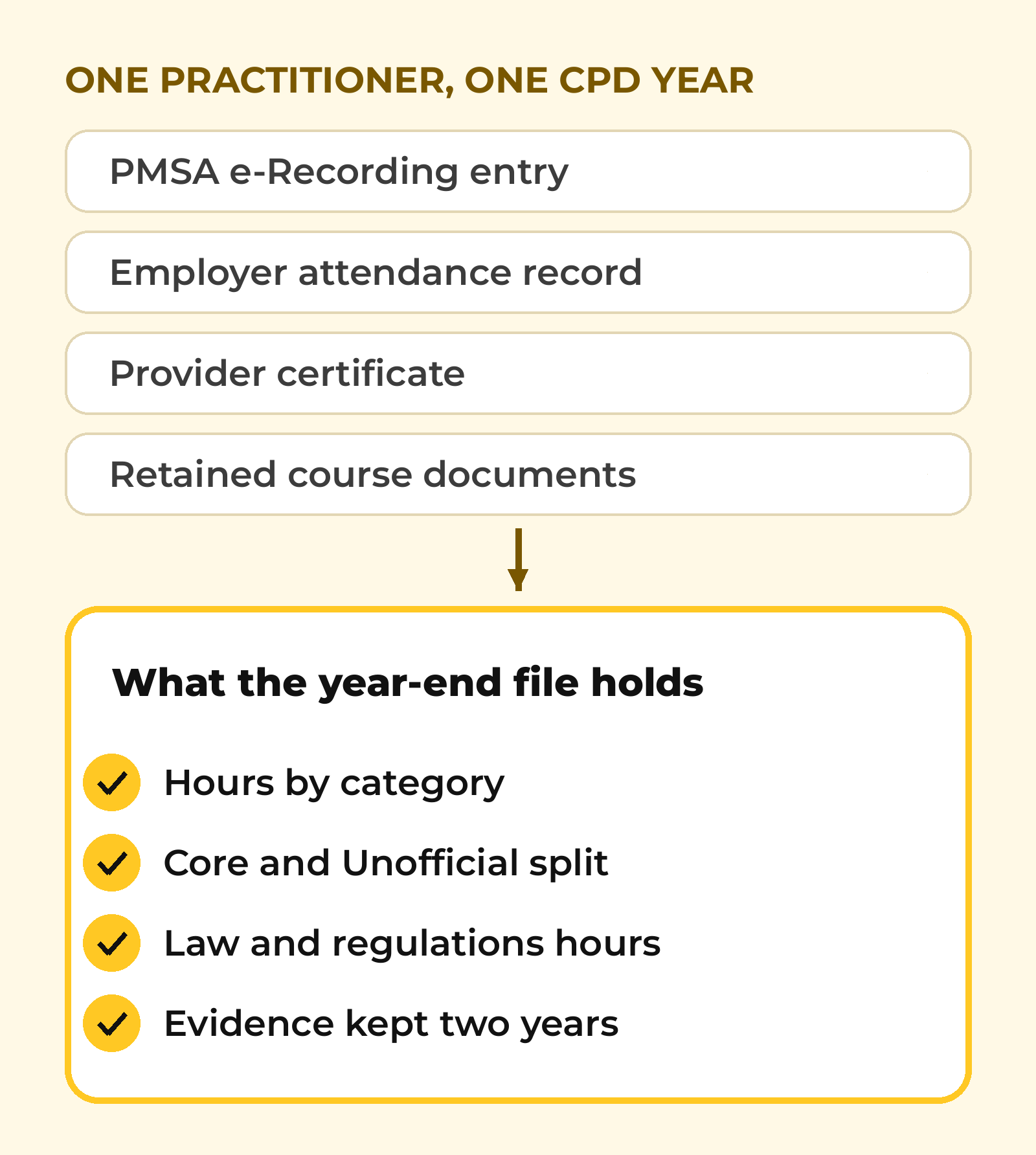
The obligation sits on the individual. PMSA operates an honour system: it accepts in good faith the information licensees provide about the activities they attended and the hours they earned, and it conducts random audits to verify that the activities were actually attended and the hours actually earned. Licensees are asked to retain supporting documents for two years. Licensees record their activities themselves through the scheme’s e-Recording System.
The evidence, meanwhile, is generated by whoever ran the training. The employer holds the attendance sheet, the sign-in record or the completion report; the provider holds the certificate; the licensee holds whatever he kept. At the end of a year, four partial records have to be reconciled into one number per person, and usually they are reconciled by the practitioner, at home, in December.
There is a legal edge to this that is worth stating plainly, without overstating it. Section 14 of the Property Management Services Ordinance (Cap. 626) makes it an offence, in connection with an application for a licence or the renewal of a licence, to provide information or a document to the PMSA that is false or misleading in a material particular, where the person knows that or is reckless as to whether it is. On conviction on indictment the penalty is a fine of $200,000 and imprisonment for 1 year; on summary conviction, a fine at level 6 and imprisonment for 6 months. The PMSA published the first conviction under that section in December 2024: a former Tier 1 licence holder was fined $1,000 with two months’ imprisonment suspended for 36 months, for failing to disclose a criminal conviction when applying. That case was about a licence application rather than a CPD record, and it is cited here only to make the point that the section is live and the information a licensee gives the regulator is not a private note.
The three facts a company needs per person
A property management company cannot hold its practitioners’ licences, and cannot make their declarations. What it can hold is the three things that decide whether the year comes together.
Who holds which licence, and when it expires. The tier determines the number, and the expiry year determines which two years are assessed. Without those two facts per person, any year-end report is an average rather than a finding.
Which of the company’s own courses are recognised, and for which category. A course that is recognised as Core and covers legislation does different work from a course that is recognised as Unofficial. If the training catalogue does not carry that classification, the count cannot be done from it.
The running total by category, per person, during the year. Not a completion rate. Three numbers: total hours, Core hours, law hours — each against the requirement for that person’s tier, read in October rather than in January.
This is the point at which a platform earns its place, and it is worth being specific about what it does. UpLearn can hold each learner’s licence registration, including the licence number, dates and validity, and the required hours can be adjusted where an individual’s position changes (capability P-02). Courses can be linked to licences so that completing a course credits the CPD/CPT hours automatically (capability P-03), which removes the step where attendance is transcribed into a spreadsheet weeks later. And CPD reports show hours earned and outstanding per assessment year and licence, with a personal record that can be exported as a PDF (capability P-07), which is the format in which a practitioner can keep his own copy.
What the platform does not do is decide recognition, or make the declaration on the practitioner’s behalf. Those stay where the Ordinance puts them. A system can make the year visible in October; it cannot make an unrecognised course count in January.
Two dates to put in the diary
The first is personal to each licence holder: the expiry year, minus two. Everything about the annual requirement follows from that date, including which years are assessed and when a shortfall can still be fixed.
The second is collective: the date by which recognition has to be in place for the first in-house session of the year. That date is earlier than the session, and it is the one most often discovered too late.
One caution belongs here rather than in a footnote. Which of your courses will be recognised, and how a licence that begins or ends mid-year is treated, are questions for the PMSA; this describes what it has published as of 18 November 2026, and it stops at the practitioner’s condition without reaching the separate licensing requirements that apply to property management companies.
Put both dates in the same calendar as the training plan. Then December becomes a check rather than a reconstruction.
Sources
- Property Management Services Authority: CPD Scheme requirements, including the CPD year, recognised hours, counting rules and mandatory implementation arrangements
- PMSA press release, 31 August 2023, on the CPD seminar at the International Property Management and Procurement Expo: mandatory participation from 1 January 2024 for Tier 1 and 1 January 2025 for Tier 2, and the licence condition on three-year licences
- PMSA: Continuing Professional Development Scheme booklet, recognised activities/courses and the e-Recording System
- Hong Kong Legal Information Institute: Property Management Services Ordinance (Cap. 626), section 14, offence relating to application for licences or renewal of licences
- PMSA, 5 December 2024: first property management practitioner licence holder convicted for providing false information to the PMSA
Cyberwisdom Asia Ltd. is a Hong Kong provider of learning management systems, CPD compliance software and bespoke courseware, serving 800+ enterprise clients since 1999.
About Cyberwisdom