On this page
Unless exempt, HKICPA members need at least 20 hours of relevant CPD each reporting year and 120 hours in each rolling three-year period, including 60 verifiable hours. The reporting year starts on 1 December. Revised ethics and structured-learning requirements apply from the reporting cycle starting 1 December 2026. This guide also compares the separate rules for SFC licensees and insurance intermediaries.
HKICPA section checked on 23 November 2026. The HKICPA sets out exemptions and requirements for specific member categories in its current guidance. Always check the official source for your status and reporting period.
CPD, CPE and CPT: the same idea, different names
Continuing professional development (CPD) is the structured learning professionals complete to keep their knowledge and skills current, as their licence, registration or membership requires. Accounting bodies often use the same term. The Securities and Futures Commission (SFC) calls its version continuous professional training (CPT). For a broader introduction, see what CPD compliance means in Hong Kong.
The three regimes compared
| Requirement | HKICPA members | SFC licensed persons | Insurance intermediaries (IA) |
|---|---|---|---|
| Who it applies to | Members of the Hong Kong Institute of Certified Public Accountants, unless exempt | Licensed representatives, responsible officers, relevant individuals on the HKMA register, and executive officers | Licensed individual insurance agents and licensed technical representatives (agent) and (broker) |
| Hours | 120 per rolling 3-year period | 10 per calendar year; 12 for responsible officers and executive officers | 15 per Assessment Period |
| Minimums within the total | At least 60 verifiable hours and at least 20 hours in every year | At least 5 hours on topics relevant to the regulated activities; at least 2 hours on ethics or compliance | At least 3 hours on Ethics or Regulations |
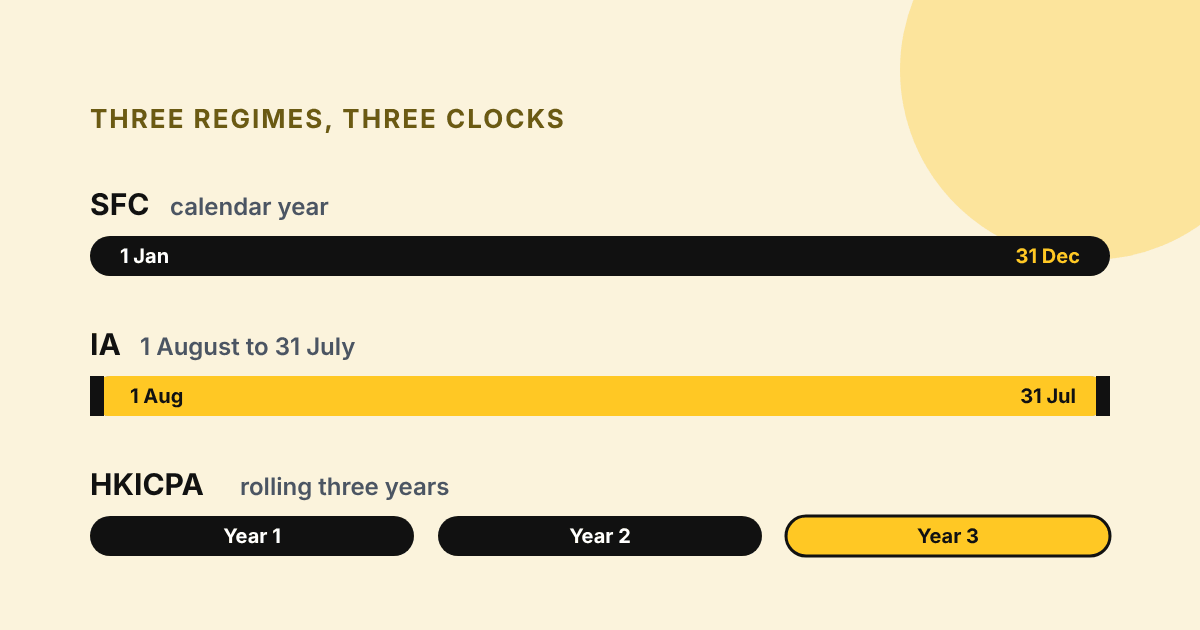
| Reporting period | Rolling three years; each reporting year begins on 1 December | Calendar year | 1 August to 31 July |
| Reporting | Records produced if the member is selected for an HKICPA audit | Corporations, responsible officers and licensed representatives confirm compliance to the SFC for the previous calendar year when filing annual returns | CPD Declaration reported to the IA and to the appointing principal by 30 September |
| Record keeping | Evidence of verifiable hours for at least 5 years | Evidence for at least 3 years | Evidence for at least 3 years after the end of the Assessment Period |
HKICPA CPD requirements in 2026
Under the HKICPA’s CPD requirement (Statement 1.500), members complete 120 hours of relevant CPD in each rolling three-year period. At least 60 of those hours must be verifiable, meaning they can be confirmed by a competent source such as a course certificate or an organizer’s confirmation. Reading professional journals is an example of non-verifiable activity. At least 20 hours are needed in every year.
Use the reporting year, not the calendar year, when planning CPD. For example, an eligible activity completed in December 2026 falls in the reporting year that begins on 1 December 2026. The 120-hour total remains the same. The HKICPA CPD FAQ and Handbook Update No. 335 set out the following changes:
- From 1 December 2025: practising certificate holders and responsible persons of registered PIE auditors must complete at least 2 verifiable ethics-related hours each year.
- From 1 December 2026, for all members: at least 2 verifiable ethics-related hours each year, within the 20-hour annual minimum; and at least 30 of the 60 verifiable hours in each rolling three-year period must come from structured learning such as webinars, workshops, e-learning and conferences.
- From 1 December 2026, for practising certificate holders and responsible persons of registered PIE auditors: at least 5 verifiable hours each year on accounting or auditing.
- From 1 December 2026, for all members: the caps on non-verifiable CPD activities are removed. Caps on some verifiable activities remain.
Members with specialist designations and responsible persons of registered PIE auditors also have their own topic minimums. Check the current Statement 1.500 for your own status.
SFC licensed persons
The SFC’s Guidelines on Continuous Professional Training apply to licensed corporations and registered institutions, and to individuals licensed or registered to carry out regulated activities. A licensed representative or relevant individual must complete at least 10 CPT hours per calendar year. Responsible officers and executive officers must complete 12, which includes 2 additional hours on regulatory compliance.
Within those hours, at least 5 must be on topics directly relevant to the regulated activities the individual is licensed for, and at least 2 must be on ethics or compliance. A new individual must also complete 2 hours on ethics within 12 months of becoming licensed. Individuals first licensed part-way through a year have pro-rated hours, hours from a previous employer in the same calendar year can count, and excess hours cannot be carried forward to the following year.
Both corporations and individuals must keep documentary evidence of CPT, such as attendance certificates or exam results, for at least 3 years.
Insurance intermediaries
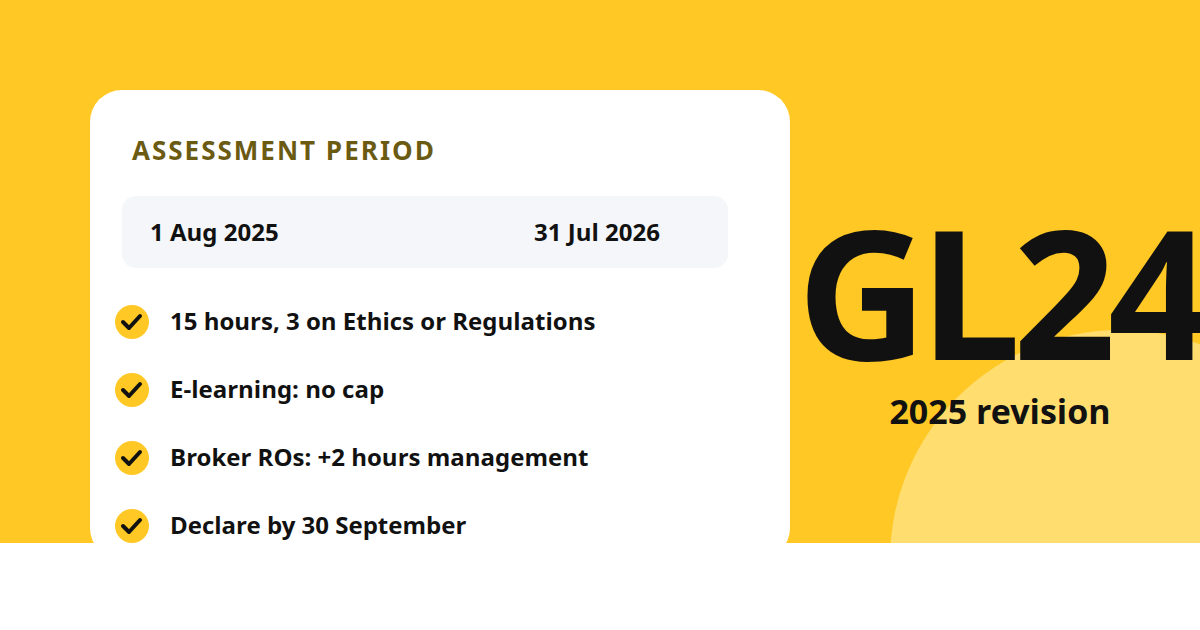
The Insurance Authority’s Guideline on Continuing Professional Development for Licensed Insurance Intermediaries (GL24) requires individual licensees to earn at least 15 CPD hours in each Assessment Period, which runs from 1 August to 31 July. At least 3 of those hours must be on Ethics or Regulations. Licensed technical representatives (agent) restricted to travel business have a lower requirement of 3 hours with no compulsory Ethics or Regulations hours.
Since 1 August 2025, a responsible officer of a licensed insurance broker company must also earn at least 2 hours on topics related to their management responsibilities, which count towards the 15.
Licensees must report their activities to the IA and to their appointing principal by 30 September, and keep evidence for at least 3 years after the end of the Assessment Period. Principals must request, check and verify the supporting evidence. The revised GL24 that took effect on 1 August 2025 removed the cap on e-learning hours and added a 2-hour management requirement for broker company responsible officers.
What this means for employers
The differences between regimes create real tracking work for any organization with more than one kind of regulated professional.
- The clocks do not line up. A calendar year, a 1 August to 31 July Assessment Period and a rolling three-year window can all apply in the same organization.
- Topic minimums are separate from the hour totals. An hour of general management training may count towards the total but not towards the ethics or regulated-activity minimum.
- Record-keeping periods differ. Evidence kept for 3 years satisfies the SFC and the IA but not the HKICPA’s 5 years. An organization serving several regimes should keep records for the longest period that applies.
- Employers have duties, not just individuals. The SFC expects firms to keep training records and confirm compliance in their annual returns, and the IA expects principals to verify evidence.
- Excess hours rarely carry over. Under the SFC and IA rules, hours above the requirement cannot be carried forward to the next period.
A practical checklist
- List every group of staff and map each to the regime that applies to them.
- Record each regime’s period, total hours and topic minimums as rules, not as notes in a spreadsheet.
- Tag every learning activity by topic, so that ethics, regulations and regulated-activity hours can be counted separately.
- Store the certificate or attendance record with the learner’s transcript, and keep it for the longest retention period that applies.
- Review progress before each deadline, not after it.
- Be able to produce a complete record for one person, or for the whole firm, on request.
Where a system helps
Spreadsheets and email folders are where this usually breaks down: different rules per regime make the formulas fragile, and the evidence lives somewhere else. An LMS with a CPD engine credits hours automatically as learning is completed, applies each regime’s rules, and produces audit-ready records. That is what UpLearn with the Cyberwisdom CPD Engine is designed to do. If you are comparing platforms, see how to choose an LMS. Cyberwisdom is a Hong Kong provider of learning management systems, CPD compliance software and bespoke courseware, serving 800+ enterprise clients since 1999.
Sources
- HKICPA: Continuing professional development requirements
- HKICPA: CPD requirements (FAQ)
- HKICPA A Plus: What's new with CPD requirements? (2026 issue 1)
- HKICPA Technical News: Handbook Update No. 335 – revised Statement 1.500
- SFC: Guidelines on Continuous Professional Training
- Insurance Authority: Guideline on Continuing Professional Development for Licensed Insurance Intermediaries (GL24, August 2025)
- Insurance Authority: CPD for licensed insurance intermediaries
Cyberwisdom Asia Ltd. is a Hong Kong provider of learning management systems, CPD compliance software and bespoke courseware, serving 800+ enterprise clients since 1999.
About Cyberwisdom